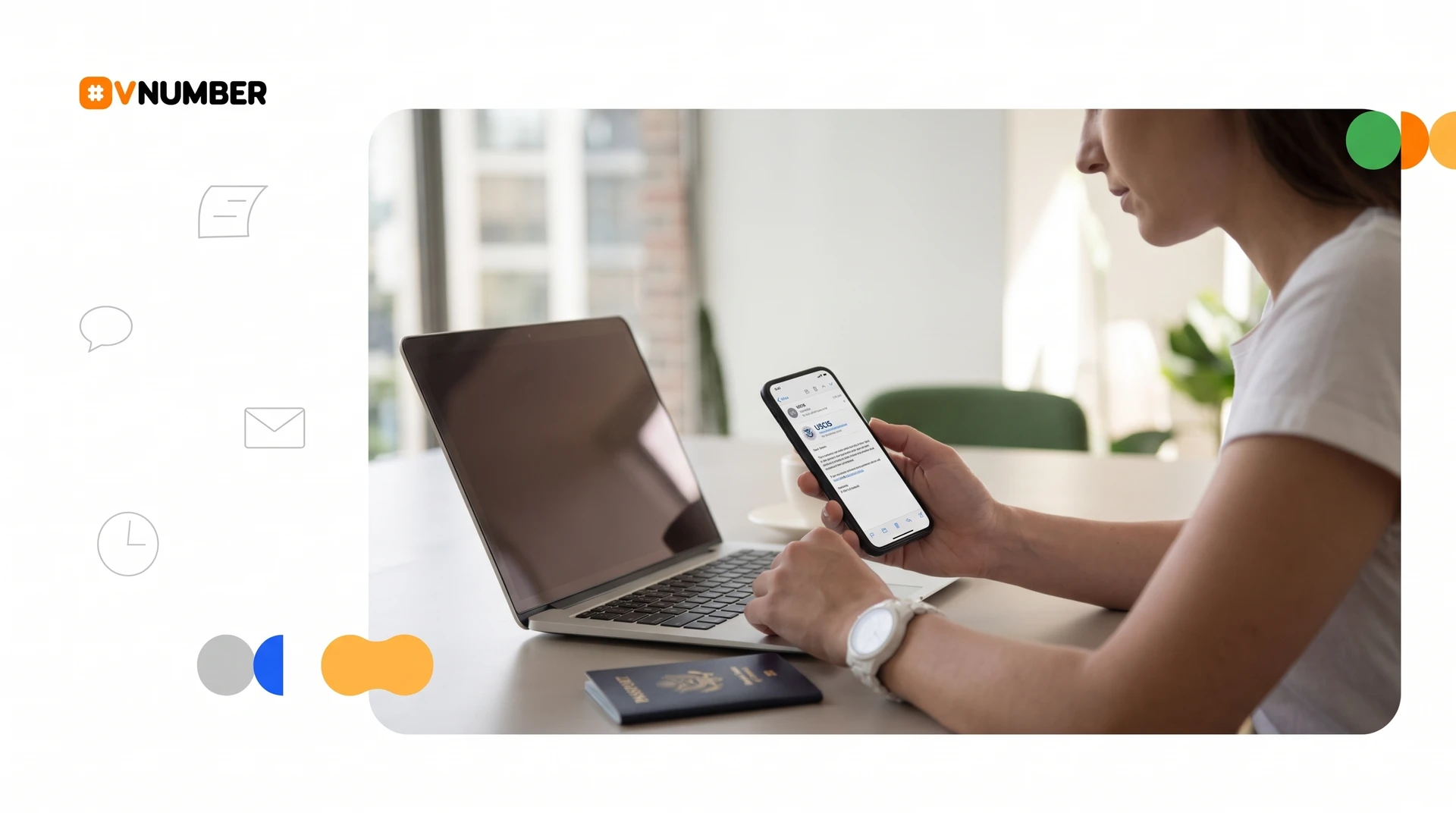
Every year, thousands of immigration applicants miss critical USCIS updates because their U.S. phone number stopped working the moment they left the country.
A missed text about a biometrics appointment or a Request for Evidence (RFE) deadline doesn’t just cause inconvenience.
It can push an entire case back by months, force a re-filing, or trigger an automatic denial. The system assumes you have a working American number at all times, and it does not wait for you to catch up.
Why USCIS Alerts Get Lost When You’re Abroad
USCIS sends SMS alerts for case status changes, appointment reminders, and document requests.
These messages go to the phone number registered in your myUSCIS account, and they follow the same delivery protocol as any standard U.S. text.
If you’re outside the country with a local SIM, those texts either bounce, arrive days late, or disappear entirely.
International roaming plans technically forward SMS, but delivery rates for short-code messages (the kind government systems use) drop dramatically outside U.S. carrier networks.
Research on short-code SMS deliverability shows that messages sent from automated platforms to numbers in roaming mode fail at rates between 15% and 30%, depending on the carrier and country.
A Stable Number for Your Immigration Case
The number you register with USCIS needs to do one thing reliably: receive U.S.-originated SMS 24 hours a day, no matter where you are.
A stable U.S. number for any citizenship or immigration process means a number that stays active for the entire duration of your case, which often spans 12 to 24 months.
Frequent travelers and expatriates face the same problem from different angles. The traveler’s local SIM keeps changing, while the expatriate’s old U.S. number eventually gets recycled by the carrier after months of inactivity.
VNumber solves this by giving you a real U.S. number that receives unlimited SMS through an app on your phone, no physical SIM required.Activation takes minutes online, and the number stays active as long as your subscription runs.
Because VNumber operates through 011Global’s telecom infrastructure (active since 2009), messages from government short codes and verification systems reach the number the same way they’d reach a traditional U.S. mobile line.
You pick a number with the area code and prefix you want, complete the setup, and start receiving texts immediately.
One distinction matters here. Not all virtual numbers handle short-code SMS equally.Some VoIP-based numbers get flagged or filtered by automated systems because they sit on ranges that carriers identify as non-mobile.
VNumber’s numbers operate on ranges that maintain compatibility with short-code delivery, which is exactly what USCIS and other government platforms use.
For applicants also tracking an ITIN application, the same reasoning applies to the number listed on an IRS identity verification form: a properly provisioned virtual number is what determines whether the notification actually arrives.
What makes a number reliable for immigration notifications
- The number receives U.S.-originated SMS 24 hours a day, regardless of your physical location or local SIM in use
- It stays continuously active for the full duration of your case, which frequently spans 12 to 24 months
- It maintains compatibility with short-code delivery, since government platforms like USCIS send alerts exclusively through automated short-code systems
- It does not get recycled or deactivated due to inactivity, which is a real risk with prepaid U.S. numbers left unused abroad
- It works independently of any physical SIM so that swapping local cards in different countries does not interrupt message delivery
What to Do If Your Number Changes Mid-Case
If your registered number stops working or you switch to a new one, update your myUSCIS account right away.
Go to the “Profile” section where your contact phone number is stored. USCIS also accepts contact changes through Form AR-11 for certain case types, and you can call the USCIS Contact Center at 1-800-375-5283 to flag the update verbally.
For applicants working with an immigration attorney, send a brief written notice as well: “Dear [Attorney Name], please update my file to reflect my new U.S. contact number [number].
My previous number [old number] is no longer active as of [date]. Please ensure all USCIS correspondence reflects this change.” That written trail protects you if a deadline gets missed and you need to show you acted diligently.
The smarter move is avoiding that situation entirely. With a service like VNumber, your number doesn’t change when you move countries or swap local SIMs.
The U.S. number lives in the app, independent of whatever physical phone setup you’re using.
A stable phone identitymatters beyond immigration too, since financial platforms and identity-sensitive services are equally unforgiving when your registered number goes dark.
The same logic applies if you’re also handling a U.S. passport renewal from abroadat the same time: one consistent number across every federal process removes the single biggest point of failure.
Steps to update your number with USCIS
- Log into your myUSCIS account and navigate to the “Profile” section to update your contact phone number right away
- Submit Form AR-11 if your case type requires a formal change-of-address or contact update through that channel
- Call the USCIS Contact Center at 1-800-375-5283 to flag the update verbally and request confirmation
- Send your immigration attorney a brief written notice stating your new number, your old number, and the date the old number became inactive
- Verify that all pending correspondence and upcoming notices reflect the updated number before your next scheduled milestone
Two Real Cases, One Variable
Consider Maria, a Colombian national living in Madrid with a pending I-130 family petition. Her old U.S. prepaid number expired three months into the process.
She missed two SMS alerts about document requests and only discovered the gap when she logged into myUSCIS weeks later.
The delay pushed her case timeline by four months. After activating a VNumber U.S. number, every subsequent notification reached her phone in Madrid within seconds.
Then there’s Daniel, a Brazilian consultant who splits time between São Paulo and New York. His active green card renewal case required him to respond to biometrics scheduling within a tight window.
With a VNumber tied to his myUSCIS profile, the appointment confirmation reached him in Brazil the same morning it was sent, giving him enough time to book a flight and appear on schedule.
These aren’t edge cases. They represent the daily reality of anyone managing a U.S. immigration process from outside the country.
The system works when your number works, with no gaps in coverage and no missed deadlines that a reliable phone number could have prevented.
Maria vs. Daniel: two outcomes shaped by one variable
|
Situation |
Without a stable U.S. number |
With a stable U.S. number |
|---|---|---|
|
Pending I-130 petition (living abroad) |
Two missed document request alerts, case delayed by four months |
Every notification delivered within seconds to the app, no missed deadlines |
|
Green card renewal (traveling between countries) |
Risk of missing biometrics scheduling window during an international stay |
Appointment confirmation received same morning, allowing timely flight booking |
Frequently Asked Questions from how to Receive USCIS Notifications When You Live or Travel Outside the United States
Can I use a foreign phone number to receive USCIS notifications?
USCIS SMS alerts are sent from U.S. short-code systems that are optimized for domestic carrier delivery. A foreign number may receive some messages, but failure rates increase significantly, and there is no guarantee that time-sensitive alerts such as RFE deadlines or biometrics notices will arrive at all.
What happens if USCIS sends me a notice and my number is no longer active?
USCIS does not retry failed SMS deliveries indefinitely. If your number is inactive, the alert is lost and your case continues to move forward regardless. This means you can miss a response deadline without receiving any warning, which may result in automatic denial or significant delays.
Is a virtual number from VNumber treated differently than a regular U.S. mobile number by USCIS systems?
VNumber’s numbers operate on ranges compatible with short-code delivery, which is the same delivery pathway used by USCIS and other government platforms. Unlike generic VoIP numbers, which automated systems often flag or filter, these numbers receive government-originated SMS reliably.
How long do I need to keep my U.S. number active during an immigration case?
Most immigration cases take between 12 and 24 months from filing to resolution, and USCIS may send notifications at any point during that window. Keeping your number active and unchanged for the full duration of your case is the safest approach to avoid communication gaps.
Do I need to notify USCIS if I change my phone number during an active case?
Yes. You should update your contact number in your myUSCIS profile, submit Form AR-11 if applicable, call the USCIS Contact Center, and notify your immigration attorney in writing. Taking all of these steps creates a documented record showing you acted promptly if any deadline issue arises later.