Every consular form asks for a phone number. That number becomes the single channel through which the embassy confirms your appointment, requests additional documents, or notifies you of schedule changes.
When the number you entered stops working, the consulate doesn’t chase you through email or social media. They move on, and you lose your slot, sometimes along with a non-refundable application fee that took weeks to secure.
When Your Contact Number for a Consular Interview Fails
The problem hits hardest during U.S. visa applications, where the process already involves long wait times and strict documentation windows.
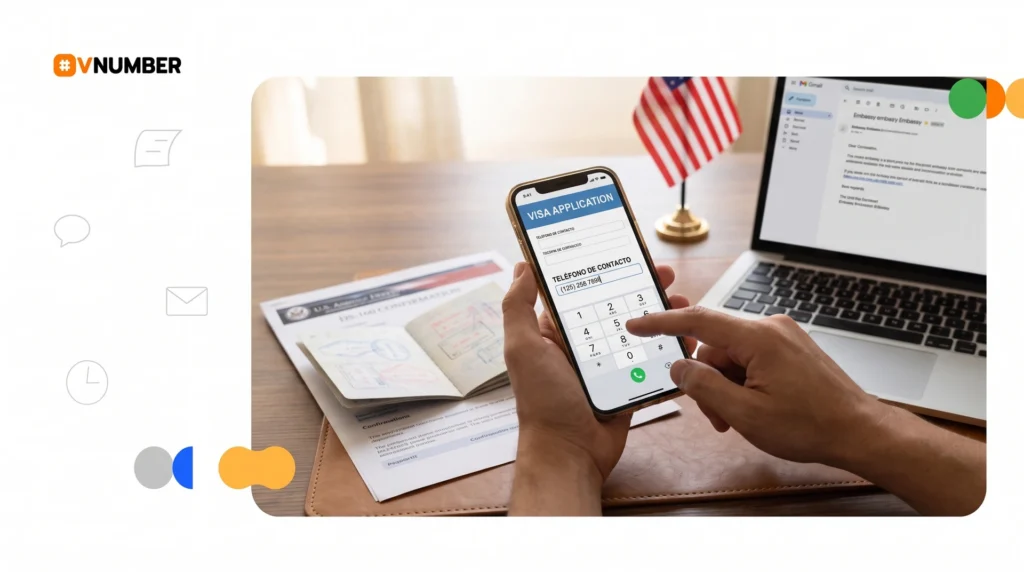
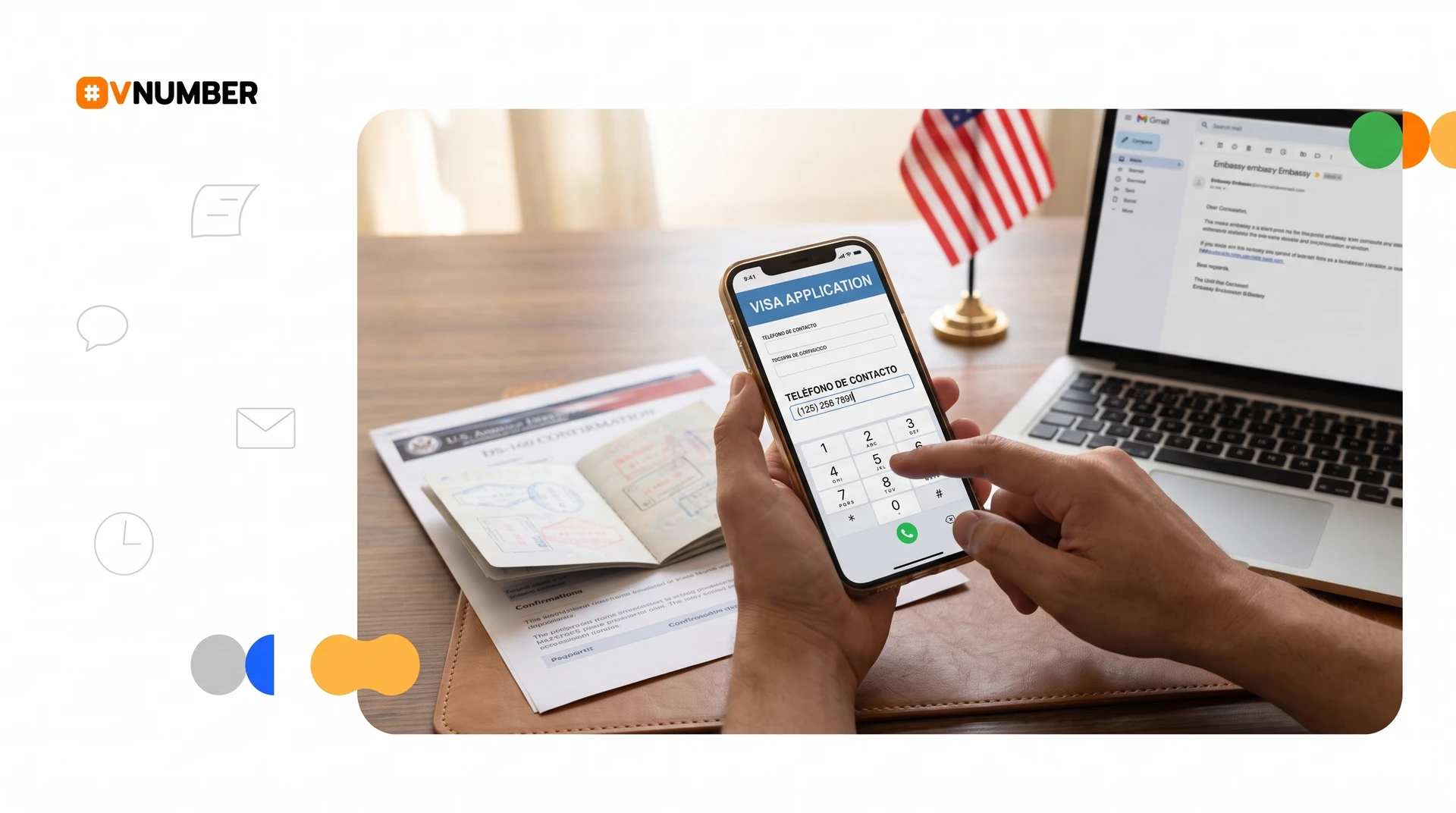
If you’re wondering which number to put on a U.S. visa application form, the answer matters more than most applicants realize.
The number you enter needs to receive both calls and SMS reliably for months after submission, because consulates send appointment confirmations, last-minute time changes, and follow-up requests through that exact channel.
A number that works today but goes dark when you cross a border turns your entire application into a gamble.
Consider a freelancer based in Mexico City who applied for a U.S. visa while planning a move to Colombia.
She entered her Mexican mobile number on the DS-160 form. Two months later, living in Bogotá with a Colombian SIM, she missed the SMS confirming her interview date.
By the time she found out through the portal, the slot had passed. Rescheduling added another eight-week wait and a second trip to the consular city.
Why Travelers Lose Their Number at the Worst Possible Time
Staying reachable throughout a consular process is harder than it sounds when your location keeps changing. Expatriates swap SIM cards when they arrive in a new country because roaming costs are brutal.
Digital nomads cycle through local numbers every few months. Students abroad let their home country line lapse because maintaining two plans feels wasteful.
In every case, the number they put on official forms becomes unreachable within weeks or months of submission.
Roaming technically keeps a number alive, but the costs make it impractical for the extended timelines consular processes demand.
Receiving a single SMS confirmation while roaming in another country triggers charges that feel completely out of proportion to the value of one text message.
And roaming coverage itself is unreliable in certain regions, meaning the SMS might never arrive even if you’re willing to pay. The deeper issue is that traditional phone numbers are tied to physical infrastructure.
A SIM card belongs to a carrier in a specific country, and when you leave that country, maintaining access requires either paying roaming premiums or trusting someone back home to check your messages.
Neither solution works for someone whose stable phone identity needs to survive a consular process that stretches across months and borders.
Common profiles that lose consular access to their number
- Expatriates who swap SIM cards upon arrival in a new country, leaving their original number unreachable within days
- Digital nomads who cycle through local numbers every few months as they move between destinations
- Students abroad who let their home country line lapse because maintaining two active plans feels wasteful
- Freelancers planning cross-border moves who enter a home number months before it goes inactive
- Retirees splitting time between countries whose roaming coverage is unreliable in certain regions
How a Virtual Number Keeps Your Consular SMS Coming
A virtual number solves the geographic problem at its root. It operates independently of any physical SIM card or local carrier, which means it stays active regardless of where you are.
You receive SMS and calls through an app on your phone, over any internet connection, in any country. For consular communication specifically, this eliminates the single biggest failure point.
The mechanic is direct. You activate a virtual number from the country where the consulate operates (a U.S. number for U.S. consular processes, for example), enter that number on your application form, and receive every confirmation, reminder, or follow-up directly on your phone through the app.
The number doesn’t expire when you travel, and it doesn’t incur roaming charges. It stays alive as long as your subscription runs.
If you’re also tracking your immigration case status, receiving case status text alertsthrough a stable U.S. number follows the same logic, and dual nationals juggling two consulates face a closely related number-choice problem.
VNumber, backed by telecom operator 011Global since 2009, handles exactly this scenario.
Activation takes minutes online. You select a country and region, choose an available number, complete your information, and start receiving unlimited incoming SMS immediately through the mobile app on iOS or Android.
For an expatriate managing a visa application across two or three countries over several months, the cost difference against roaming charges is dramatic: a flat monthly rate versus unpredictable per-message fees that accumulate silently.
Consular SMS messages from appointment systems arrive through standard telecom protocols, and virtual numbers receive them the same way a physical SIM would.
The difference is that your virtual number travels with you without any carrier switching or coverage gaps.
Virtual number vs. roaming: what changes for a consular applicant
|
Factor |
Roaming SIM |
Virtual Number |
|---|---|---|
|
Works across countries |
Yes, but with unpredictable fees per message |
Yes, at a flat monthly rate with no per-SMS charges |
|
Coverage reliability |
Varies by region and carrier agreements |
Consistent over any internet connection |
|
Number stays the same |
Only if you keep the original SIM active |
Always, regardless of physical location |
|
Setup before form submission |
Requires original SIM to be in your possession |
Activated online in minutes from anywhere |
Set Up Your Number Before You Submit the Form
Secure your contact number before you fill out any official paperwork. The timing mistake most applicants make is solving the phone number problem after they’ve already submitted their application.
By that point, changing the contact number on a consular form ranges from difficult to impossible depending on the system.
For a U.S. visa process, that means activating a virtual number, testing it by sending yourself an SMS, and then entering it on the DS-160 or appointment portal.
Confirm the number appears correctly with the country code and keep the app installed and notifications enabled on your phone so that incoming messages from the consular system reach you instantly, whether you’re in Buenos Aires, Berlin, or Bangkok.
Freelancers running client work across borders, retirees splitting time between countries, and students moving for academic terms all share the same vulnerability.
Their physical location changes, but their consular paperwork stays frozen with whatever number they entered months earlier.
A virtual number absorbs that instability completely, keeping your contact channel under your control with transparent pricing and no surprises on your bill. That predictability changes the entire experience in a process already full of uncertainty.
The same principle applies whenever official systems rely on SMS for identity verification, since a number that goes dark mid-process creates failures that are hard to reverse.
Frequently Asked Questions from what Phone Number Should You Put on Your Visa Application or Consular Interview
Can I update my phone number on a consular form after submitting it?
In most systems, updating a submitted contact number is either very difficult or not permitted at all. That’s why choosing a stable, location-independent number before submission is the only approach that reliably avoids missed communications.
Does a virtual number actually receive SMS from embassy appointment systems?
Yes. Consular appointment systems send SMS through standard telecom protocols, and virtual numbers receive those messages the same way a physical SIM does. The app delivers them to your phone over any internet connection, in any country.
What country’s number should I use on my visa application?
Use a number from the country where the consulate operates. For a U.S. visa application, a U.S. virtual number is the safest choice because it matches what the appointment system expects and avoids any international format issues.
Are free virtual numbers safe to use for official consular communication?
Free virtual numbers are shared across many users and carry significant reliability risks for official communications. A paid private virtual number is the appropriate option when the contact channel is tied to a visa application or consular appointment.
How long does it take to activate a virtual number and start receiving SMS?
With services like VNumber, activation takes only a few minutes online. Once you select your country, choose a number, and complete your information, incoming SMS arrive through the mobile app immediately.